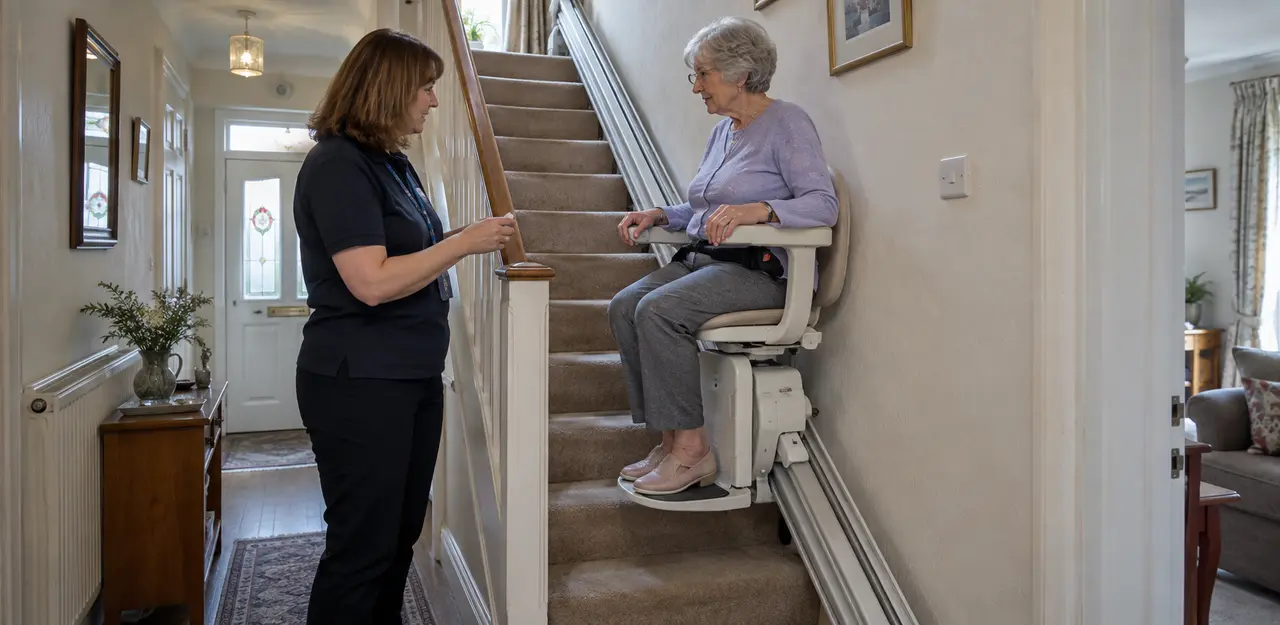
The rail is only one part of the decision
Choosing a stairlift that will actually be usable
A stairlift can restore access to bedrooms and bathrooms without major structural work. It still has to fit both the staircase and the person. Being able to sit on a showroom model doesn't show whether somebody can get on safely at a narrow top landing or reach their walking frame after the journey.
Can the person transfer safely?
The user normally needs to approach the seat, turn, sit and position their feet. At the other end they must reverse the movement without standing close to the open staircase. Painful knees, poor balance, one-sided weakness or dizziness may make this harder than expected.
A powered swivel seat and folding footrest can reduce some movements, but controls differ. Try them with the coat, footwear and walking aid normally used.
Straight stairs and curved stairs
A straight lift runs on a rail without bends or landings. Where the staircase turns, the rail is usually made to follow it, which adds cost and lead time. Sometimes two straight lifts are proposed with a transfer at the landing. That can be cheaper, but it is unsuitable if the person can't stand and move between seats safely. Find out whether the rail parks away from a doorway and whether a hinged section needs lifting after use.
Space at the top and bottom
The folded lift narrows the staircase for everyone else. Measure the remaining route at handrail height as well as near the treads. At the bottom, the rail and footrest must not block a hall, front door or escape route.
At the top, the safest arrangement often allows the seat to swivel so the user gets off onto the landing instead of towards the stairs. Request drawings showing the actual parked positions.
New, reconditioned and rented lifts
A reconditioned carriage can be a reasonable purchase when its condition, warranty and service history are clear. A curved rail is normally specific to one staircase even if other parts are reused.
Rental may suit recovery or an uncertain period, though installation, removal and minimum terms affect the total. Find out what happens if the user’s weight, posture or transfer ability changes during the agreement.
Compare complete written prices
The quotation should identify the model, rail, powered features, installation, electrical supply, warranty, call-out arrangements and servicing. Find out what a breakdown visit costs after the warranty.
Batteries commonly allow limited use during a power cut, but they need charging and eventual replacement. Pressure to sign during the first visit is a good reason to pause and compare another proposal.
Find out who will use the staircase on foot and whether they can pass the folded lift. Children, visitors and another household member carrying washing all need room. If the lift finishes close to an external door, check for cold draughts and water reaching the charging points.
Decide where the remote controls will live and whether the user can call the chair from either floor. The installer should demonstrate emergency procedures to more than one person and leave written instructions that can actually be found later. If the household expects to move, ask what removal will involve and whether a curved rail has any resale value. These points are rarely the first things shown in an advert, but they affect the usefulness and total cost over several years.
When a stairlift is no longer the right answer
A person who can't remain safely seated, can't transfer at either end or needs to travel in a wheelchair may need a different arrangement. A home lift or downstairs living can be considered, subject to space and assessment.